Futh’s first trip to Germany and the unreturned silver lighthouse
The Lighthouse (Alison Moore Edition)Futh’s first trip to Germany with his father becomes the setting for a failed attempt to return the silver lighthouse perfume case to its rightful heir. The visit to Great-Uncle Ernst turns a family keepsake into the subject of an unfulfilled obligation: Ernst identifies the case as his mother’s property, while Futh’s father admits that it cannot be returned. For Futh, the meeting also binds the object to a childhood journey marked by loneliness, watchfulness, and the discovery that the family story he has been given is incomplete.
The journey and the object
Futh and his father cross to Europe by ferry in daylight. His father takes him to the cinema and buys him popcorn, sweets in a duty-free mug, and more packets of peanuts than Futh can manage. The excess leaves Futh feeling sick in the car on the journey from the ferry to their hotel in Germany. The trip holds these ordinary gestures of care alongside a loneliness that the child cannot readily name.
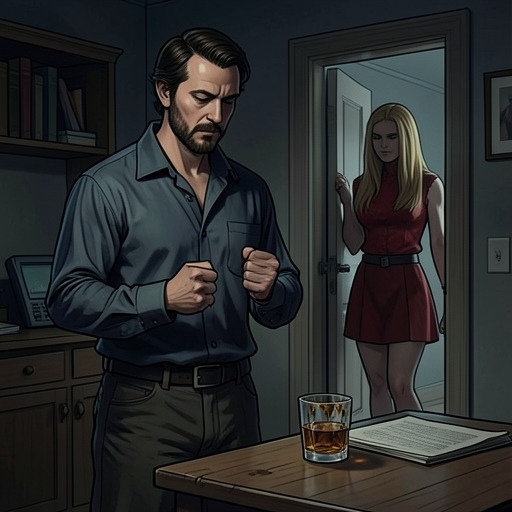
At the hotel, the two have separate beds and a small bathroom. When Futh wants a night light, his father leaves the bathroom light on and the door ajar, telling him to sleep. Futh instead watches the strip of light in the mirror behind the sink as his father changes, combs his hair, and brushes his teeth before leaving the room. At night, Futh sees his father return with a different woman on successive occasions; in the morning, his father says Futh slept well, while Futh keeps his disturbed nights to himself. The light through the bathroom doorway gives the child a way to watch without being seen, but the mirror also makes the hotel room a place of uneasy knowledge.
The silver lighthouse perfume case travels with Futh inside a secret pocket of his kagoul. His father keeps the passports and Deutschmarks in a comparable inner pocket because he does not trust the hotel staff. For Futh, the lighthouse is not merely luggage: as an adult recalling the trip, he remembers always taking it when he travels, as though it were a Saint Christopher. The case is physically close to him during the visit, even while the history of its ownership remains hidden from him.
The visit to Ernst
Futh and his father go to Ernst’s house without arranging the visit or knowing whether he is alive, whether he still lives in his parents’ house, or whether the house remains standing. They go on speculation, since the hotel is close enough for a day trip. They arrive at lunchtime and find the house intact, inhabited, and well maintained. After Futh’s father knocks, they wait, notice a net curtain twitch upstairs, and nearly leave before Ernst finally opens the door.
Futh expects Ernst to resemble his grandfather, whom he remembers only as ill and shrunken. Instead, Ernst is large and solid. He welcomes the visitors inside, takes their matching kagouls, and leads them upstairs to the living room. While he fetches coffee and milk, cats return to the chairs and settle in the guests’ laps. Ernst speaks German with Futh’s father, so Futh cannot follow most of the conversation. When Ernst tells Futh in German that he looks like his brother did at the same age, Futh does not understand; his father confirms that the boy does not speak German. Ernst says that he should learn it.
The purpose of the visit becomes explicit when Futh’s father explains that his own brother had suggested they come. Ernst asks whether the brother sent anything for him. Futh’s father says no. The exchange is brief, but it brings the unreturned object into the room without resolving why it is missing. Futh, meanwhile, looks at the few photographs on the sideboard. He mistakes an old picture of his young grandfather for a picture of himself, then recognizes a similar portrait of Ernst as a boy and understands his error. The photographs show him that his grandfather had written home and sent pictures; for a moment, this gives Futh reason to hope that his mother may have done likewise.
The disputed inheritance
Ernst explains that his brother left home after getting a girl into trouble and fearing a beating from her brothers. The family, he says, was not greatly surprised by the reason for the departure. What surprised them was that the departing brother took their mother’s few valuables. Most were returned by post soon afterward; the exception was a perfume bottle in a silver case. Ernst believes his brother must have given it to Futh’s mother.
Futh’s father answers that the case had remained intact in his father’s possession into his eighties and had been given to his wife. Ernst insists that it belonged to his mother and was his to inherit, adding that it had value and ought to be returned. The disagreement makes the case more than an easily misplaced family possession: it is the one valuable whose return was never completed, and its absence exposes a breach between the brothers that the visit cannot repair.
Futh’s father says that he and his wife are separated and that he has no address for her. After a pause, he adds that the bottle is broken anyway. Ernst replies that if it cannot be returned, his brother should pay him for it. The conversation thus ends without the object, a way to retrieve it, or an agreed settlement. The account also leaves the case’s material history divided between Ernst’s claim that it should have been returned and Futh’s father’s assertion that it has already been broken.
Departure and significance
The visit ends without a reconciliation or a handover. Futh’s father puts down his empty coffee cup and says they should leave. Futh struggles to rise and is scratched when the cat falls from his lap. At the door, Ernst hands back their kagouls, studies Futh, and tells him that he is just like his brother. The resemblance gives the disputed inheritance a personal edge: Futh is not only carrying the missing case but is also being compared to the family member whose departure and taking of the valuables began the dispute.
Outside, Futh follows his father down the street and turns back to see whether Ernst is still watching. The walk to the car seems very long; inside the small secret pocket, the lighthouse feels huge and bangs against Futh’s chest. The final image keeps the heirloom both concealed and insistently present. In the adult frame, Futh still carries the lighthouse when he travels, gripping it in his pocket. The recalled visit explains why that habit is shadowed by more than comfort: the object is associated with an inheritance left unsettled, a claim he heard but could not understand, and a return that never took place.